Enterprise AI Development
Build governed AI systems that work with real enterprise data, permissions, workflows and human decision-making.
EWS engineers production-shaped AI systems: retrieval that respects identity, answers that cite evidence, and actions that wait for application policy and human approval. The model is a reasoning component, not the security boundary.
What EWS builds
Capabilities we can stand behind
Enterprise RAG
Retrieval is filtered by identity before the model sees context. CareAgent selected hybrid RRF plus reranking over embedding-only lookup after measured retrieval evaluations.
Grounded answers and citations
Answers are labelled when grounded and linked to approved sources a reviewer can open. Missing evidence is an abstention, not an invented reply.
Permission-aware retrieval
Authorization happens before model context. Unauthorized chunks are not sent to generation. Seeing evidence and executing a tool remain different controls.
Bounded agentic workflows
Consequential work is modelled as an application workflow with state, policy and approval — not an open-ended autonomous loop. CareAgent rejected LangGraph for appointment support for that reason.
Approval-controlled actions
High-risk writes wait in an awaiting-approval state. Nothing is submitted until a reviewer approves, and permissions are checked again before execution.
Model and provider integration
Generation sits behind a provider boundary. CareAgent defaults to a local synthesizer. An OpenAI adapter exists and is gated. Dockerized Ollama is an opt-in local option.
Guardrails and evaluation
Structured output validation, retrieval evaluations, and a synthetic adversarial harness sit in application code. They are engineering controls, not a legal certification.
Auditability
Proposal, decision and result are traceable. The application owns the audit trail so a reviewer can see why an answer or action was produced.
An EWS engineering principle
The model may propose. The application decides.
This is not a universal industry rule. It is the principle already demonstrated by CareAgent. Prompts are not a security boundary. Identity, retrieval filters, tool policy, approval and execution stay in deterministic application code.
- LLM reasoning proposes answers or tool calls
- Application policy owns what is allowed
- Identity and permissions run before model context
- Retrieval returns only authorized candidates
- Business tools execute in application-owned code
- Human approval gates consequential writes
- An audit trail records proposal, decision and result
Enterprise RAG
Why naive vector search is not enough
Embedding a corpus and asking a model to “only use what the user should see” treats the model as an authorization system. If unauthorized chunks enter context, a prompt cannot reliably unsay them. CareAgent therefore authorizes first, then retrieves.
Retrieval quality is an engineering problem, not a slogan. Operational language is precise. CareAgent’s Phase 3 evaluations selected hybrid reciprocal-rank fusion plus reranking over embedding-only lookup. Historical metrics stay in the project; they are not republished here as marketing scores.
Grounded generation is paired with citations so a reviewer can open the approved sources. When evidence is missing, authorization fails, or an action is uncertain, the system abstains or denies rather than inventing a safe-looking answer. Fail closed is a product decision.
Evaluation is part of the build, not an afterthought. CareAgent includes an evaluations lab for retrieval and safety checks, plus a synthetic adversarial harness. That harness is not a clinical or regulatory result.
Agentic AI
Workflows with tools, state and approval
When EWS says agentic AI, it means a system that can reason, call tools, keep workflow state, and stop for policy — not an “autonomous employee.” CareAgent’s appointment support is a deterministic application workflow. A grounded answer does not imply permission to act.
Reasoning stays in the model. Tools, ownership checks, time-bound approval, re-authorization and idempotent execution stay in the application. That split is what makes the system inspectable when something goes wrong.
Controlled execution is the point. High-risk writes wait. Reviewers see the proposal. The application records the decision. This is slower than a chatbot that “just does it,” and that is the intended trade-off for enterprise operations.
Governance and safety
Controls, not certificates
Guardrails
Output validation and structured firewalls sit after generation. They constrain what the application will accept, not what a model can be talked into.
Authorization
RBAC and ACL run before context assembly. Unauthorized content must not enter the model. Permissions are checked again before a tool runs.
Human approval
Consequential actions require an explicit, time-bound decision. The model may propose. A reviewer and the application decide.
Data boundaries
CareAgent uses synthetic data. It is not hospital production, not a medical device, and not HIPAA or GDPR certified. Hosted OpenAI live evaluation has not been executed.
The homepage describes EWS AI services as EU-ready in the sense of engineering for European enterprise constraints — identity, evidence, approval and audit. That is not a claim that EWS certifies GDPR, the EU AI Act, or any other legal regime.
Engineering evidence
CareAgent, a production-shaped demonstrator
CareAgent is a production-shaped engineering demonstrator for healthcare operations — synthetic data, a real product UI, and closed phases for retrieval, approval, evaluation and provider abstraction. It is not a hospital deployment, not clinical decision support, and not real patient production data. AegeanCare is a fictional reference network.
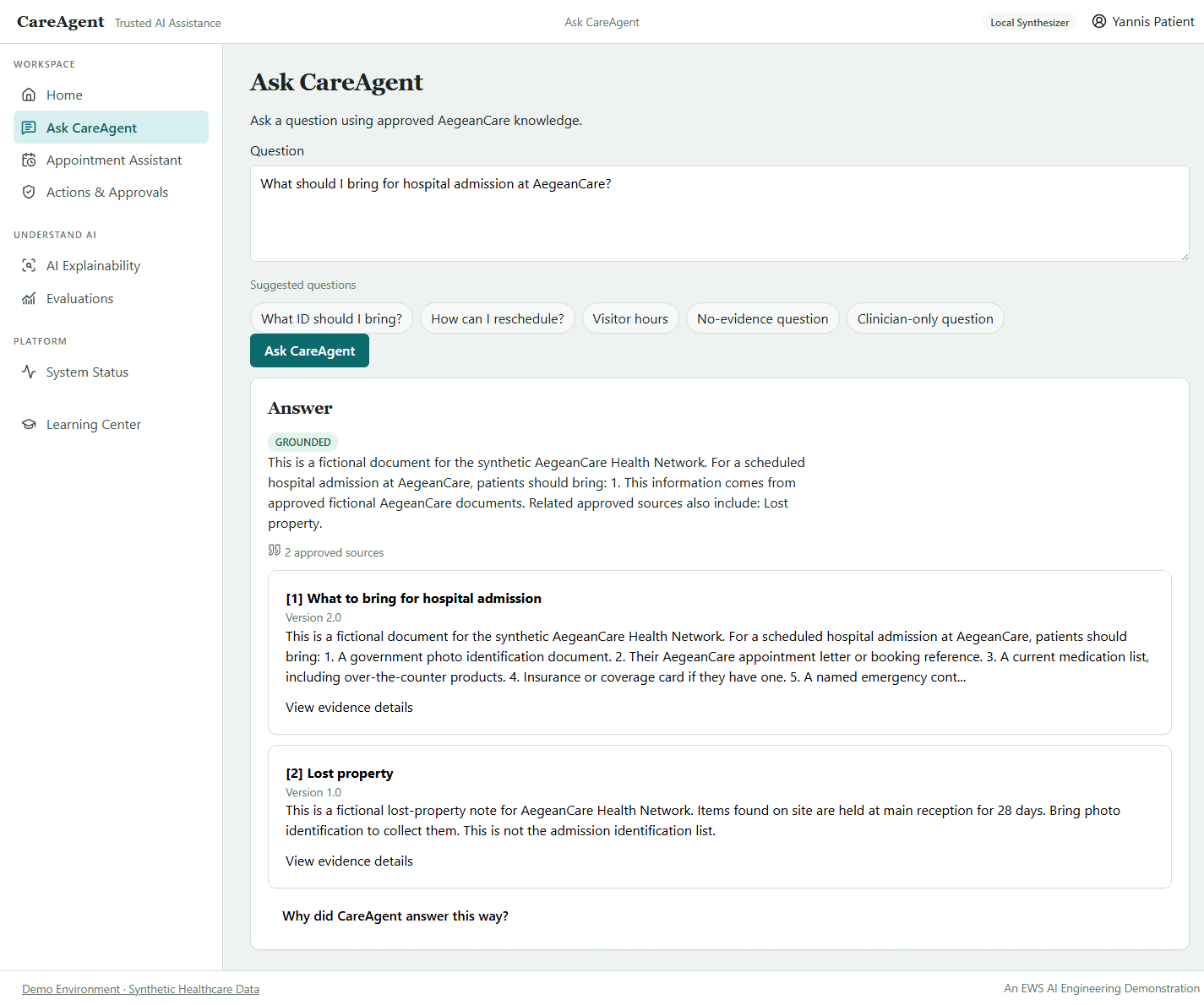
Engineering Example
EWS CareAgent
Governed agentic AI with permission-aware retrieval, cited evidence and approval-controlled actions.
Python · FastAPI · pgvector
Technology
Stack by layer
Discuss an enterprise AI architecture
Bring the workflow, the systems of record, and the permission model. We can talk through RAG design, agentic workflow boundaries, and how the application should stay in charge.
Contact EWS